
What New Yorkers Ask Before Choosing Anxiety Care
📌 Key Takeaways
Good anxiety care starts with clear questions, not perfect certainty.
Questions Come First: Asking about fit, process, and next steps can make care feel less overwhelming.
Disruption Matters: Anxiety may need attention when sleep, work, relationships, or daily confidence start to suffer.
Care Should Fit: Therapy, medication review, wellness support, and psychiatry can work together when needed.
Medication Is Collaborative: Medication may be part of care, but thoughtful treatment should not push one default path.
Urgency Has Limits: Outpatient care fits planning questions, while immediate safety concerns need crisis or emergency support.
Clear questions turn anxiety care from a leap into a steadier first step.
New Yorkers unsure about anxiety care will gain calmer decision-making language here, preparing them for the detailed overview that follows.
~ ~ ~ ~ ~ ~ ~ ~ ~ ~ ~ ~ ~ ~ ~ ~ ~ ~
Phone in hand, comparing provider pages from a small apartment after a long day. The questions forming in your mind feel almost too personal to say out loud — too basic, maybe, or too urgent. That pause before reaching out is one many New Yorkers know well.
This article is for informational purposes only and cannot replace clinical evaluation. What it can offer is a clear walk-through of the questions that tend to come up before choosing anxiety care — so that the act of reaching out feels like a considered step rather than a leap into the unknown. Integrative Psychiatry is one pathway worth understanding but knowing what to ask comes first.
The Questions Are Part of the Decision
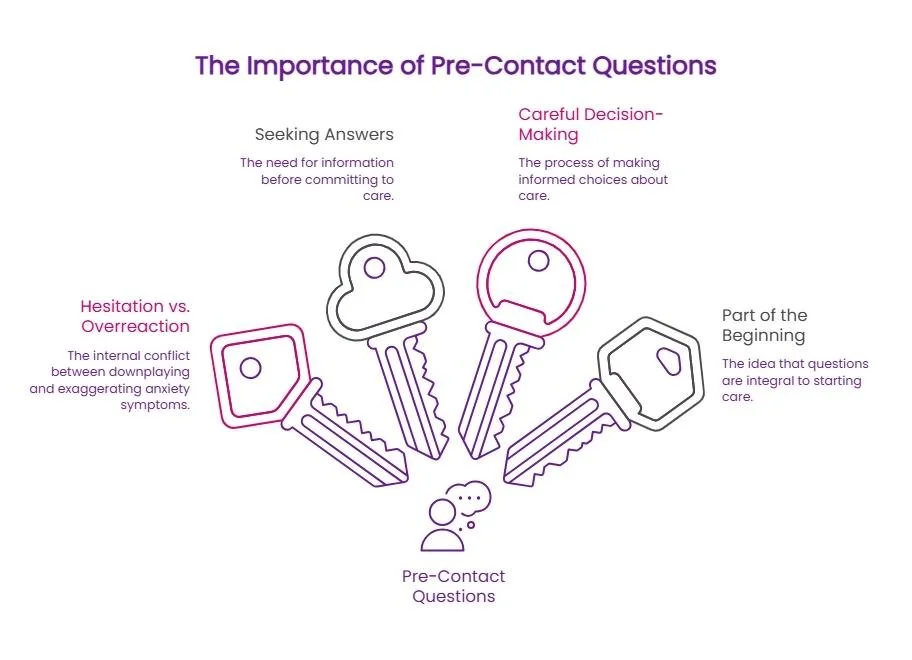
When anxiety escalates — through panic attacks, disrupted sleep, recurring difficulty at work, or a quiet but persistent sense that something has shifted — the instinct is often pausing before acting. Some people worry that asking questions is a sign of hesitation or overreaction. Others feel caught between thinking it wasn't that serious and fearing something is genuinely wrong.
Both feelings can coexist, and neither disqualifies anyone from seeking support.
Many people need answers before they feel ready to begin care.
Pre-contact questions aren't avoidance — they're how careful people make good decisions. A care pathway worth choosing should make room for questions about fit, process, and what happens next. That's not a barrier to beginning; it's part of beginning.
Common Questions New Yorkers Ask Before Choosing Anxiety Care
How do I know whether anxiety care is the right next step?
If anxiety has started affecting daily functioning — straining relationships, making work harder to sustain, disrupting sleep, or eroding confidence over time — that disruption is worth taking seriously. A formal diagnosis isn't required to recognize that something has shifted. The National Institute of Mental Health notes that anxiety disorders involve more than occasional worry or fear and can interfere with daily life. The signs and symptoms vary considerably from person to person, which is part of why evaluation with a qualified provider is often more clarifying than self-assessment alone.
What kind of provider should I look for if panic or anxiety has started disrupting my life?
The right fit depends on the nature of the disruption. Some people benefit most from Psychotherapy — structured, personalized work that addresses anxiety through conversation, pattern recognition, and lived history. Others may need psychiatric evaluation, Medication Management, Integrative Mental Health & Wellness support, or a plan that coordinates several of these. A practice that can describe its approach honestly — before any commitment is made — is usually a useful place to start.
What happens before an intake or first appointment?
A practice can help clarify what to expect when you reach out. Generally, initial contact may involve some basic information about what's been happening and what kind of support feels relevant. You can ask what the first step looks like, what information might be helpful to have ready, and how the practice determines whether its approach is a good fit. Using language like "what might this look like for me" gives the practice a reasonable opening to explain its process without locking anyone into a commitment.
Will I be pushed toward medication?
In a thoughtful practice, medication is one possible element of care — not a default or a foregone conclusion. Medication review can be collaborative and may form part of a broader plan, or it may not be part of the picture at all. If this is a concern worth raising before scheduling, it's a completely reasonable one. The goal is shared decision-making, not a predetermined outcome.
Can therapy, psychiatry, wellness support, and medication review work together?
They can, and for many people experiencing anxiety disorders, a coordinated approach may be more effective than a single modality alone. Integrative Psychiatry considers the whole person: emotional patterns, biology, life history, goals, sleep, stress load, and body signals together. Care may draw from psychotherapy, psychiatric evaluation, medication review, and Integrative Mental Health & Wellness support — which may include nutrition, nutraceuticals, mindfulness, nervous-system regulation, and sleep support — in whatever combination fits the individual's situation and preferences.
How should I think about urgent symptoms versus outpatient care?
Outpatient evaluation is for situations where the question is what kind of care fits — not do I need help right now. If panic disorder or acute anxiety has escalated to the point of feeling dangerous, or if there is any concern about immediate safety, calling 911 is the right step. For mental health crisis support in New York City, NYC 988 provides free, confidential support by phone, text, or chat, available 24/7. Phone support includes translation services in more than 200 languages (New York City Department of Health and Mental Hygiene, NYC 988 guidelines). SAMHSA's 988 Lifeline offers national support for people experiencing suicidal crisis or mental health-related distress. Outpatient inquiry and crisis response serve different needs—and recognizing this distinction ensures patients receive the safest, most appropriate level of care.
What should I ask a practice before deciding whether it feels like a fit?
The checklist in the next section is a practical place to start.
What if I'm unsure whether I need therapy, psychiatry, medication, interventional care, or something else?
That uncertainty is not a problem to solve before reaching out — it's exactly the kind of question a collaborative practice expects. Most people who contact a practice for the first time don't yet know precisely what they need. A first message can be the beginning of a conversation, not a commitment to a specific service. Practices that approach care thoughtfully will generally help clarify what a reasonable first step might look like. You can also review the practice's Anxiety Disorders page for condition context, while keeping in mind that online information cannot replace a personalized evaluation.
How can I choose care without feeling reduced to a diagnosis?
Look for a practice that makes room for both symptoms and context. A diagnosis can be useful when clinically appropriate, but it is not the whole picture of a person. Whole-person anxiety care may ask what changed, what helps, what worsens symptoms, what your body is signaling, what support already exists, and what kind of care feels possible right now. That wider frame moves the question away from "What is wrong with me?" and toward "What support fits this moment?" — which tends to produce better care.
What a Whole-Person Anxiety Care Pathway May Consider
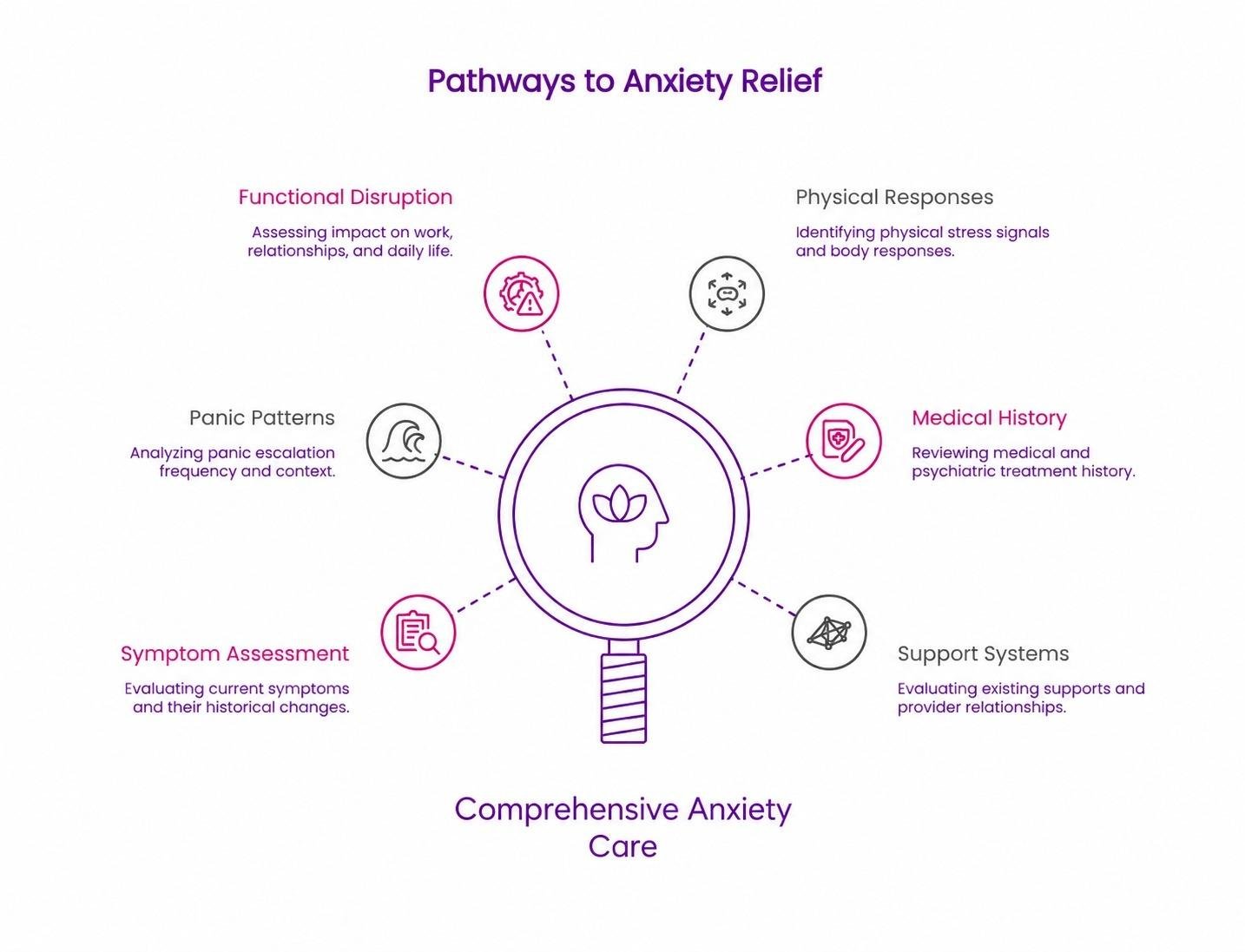
An integrative approach to anxiety care looks beyond a single symptom or a single treatment. A whole-person evaluation may consider:
Current symptoms and how they have shifted over time
Panic or anxiety escalation patterns, including frequency and context
Functional disruption in work, relationships, sleep, or daily routine
Physical responses to stress and body signals
Medical and psychiatric history, including previous treatment experience
Existing supports and relationships with other providers
Treatment goals and what meaningful improvement would actually look like
Care preferences, including comfort with medication, therapy, or interventional options
Safety and urgency boundaries — whether outpatient care is the right level of support
Depending on the individual's situation and goals, care may also include mindfulness-based approaches, nervous-system regulation strategies, and sleep support as part of a broader wellness framework.
Questions to Ask Before Contacting a Practice
Having a few clear questions ready before reaching out can make the first contact feel less daunting. These don't need answers all at once — they're a starting point.
What kinds of anxiety care do you offer?
How do you determine whether therapy, medication review, interventional psychiatry, or wellness support is the right first step?
What happens after I send a message?
How do you handle safety concerns or urgent symptoms?
How collaborative is the treatment planning process?
Can care be coordinated if there's already a therapist, psychiatrist, or primary care provider involved?
How do you support people who feel unsure, overwhelmed, or worried about being pressured?
If I'm not sure what I need yet, can I still reach out and ask about fit?
Where is the office located?
Is there a page for insurance and billing information?
No preparation is required to use this list. It exists to give you something concrete to stand on when the conversation begins.
A Gentle Next Step
If there has been a panic episode, a stretch of disrupted functioning, or a growing sense that anxiety is narrowing your options — those experiences are worth discussing with someone qualified to help. Arriving without a clear answer about which service fits is not a problem. That's what the first conversation is for.
Message New York Integrative Psychiatry to ask what a first step may look like. The contact form includes an option for people who aren't certain yet — "I'm unsure about what I need but would like to find out more" is a completely valid way to begin. To learn more or to speak with someone directly, call or text 646-859-2339.
Disclaimer: This article is for informational and educational purposes only and is not a substitute for professional medical advice, diagnosis, treatment, crisis support, or emergency care. If you are in immediate danger or need urgent medical attention, call 911. If you are experiencing suicidal thoughts, emotional crisis, or mental health-related distress in New York City, call or text 988 for immediate support.
About the New York Integrative Psychiatry Insights Team
New York Integrative Psychiatry is an integrative psychiatry practice headquartered in Manhattan, with in-person and virtual services available across New York. The practice offers psychotherapy, medication management, ketamine services, and integrative mental health and wellness support through a whole-person, collaborative care model.