
Questions That Make Medication Feel Less Pressured and More Collaborative
📌 Key Takeaways
A medication review can start with questions, not pressure, and may help protect a patient’s sense of control.
Questions Reduce Pressure: Asking about medication does not mean agreeing to start medication.
Pace Still Matters: A careful review can leave room for fear, hesitation, and slower decisions.
Goals Come First: Medication talks should connect to daily struggles, not just a diagnosis.
Care Can Be Broader: Medication may fit with therapy, sleep work, mindfulness, movement, or wellness support.
Uncertainty Belongs There: Patients can say they feel nervous, unsure, or afraid of being rushed.
Clear questions help turn medication from a feared decision into a shared conversation.
People seeking anxiety support without feeling rushed will gain calmer language here, preparing them for the detailed overview that follows.
~ ~ ~ ~ ~ ~ ~ ~ ~ ~ ~ ~ ~ ~ ~ ~ ~ ~
You want help with anxiety, but the word "medication" makes your shoulders tense. Your hand pauses over the contact form, and part of you wonders whether asking for help means being rushed into a decision before you feel ready.
That fear makes sense. When anxiety or panic has started to disrupt daily life, it can already feel as if control is slipping. The thought of a medication conversation may bring up another worry: What if this becomes one more place where control is taken away?
A medication review does not have to begin with pressure. It can begin with questions.
You Can Ask About Medication Without Agreeing to Medication
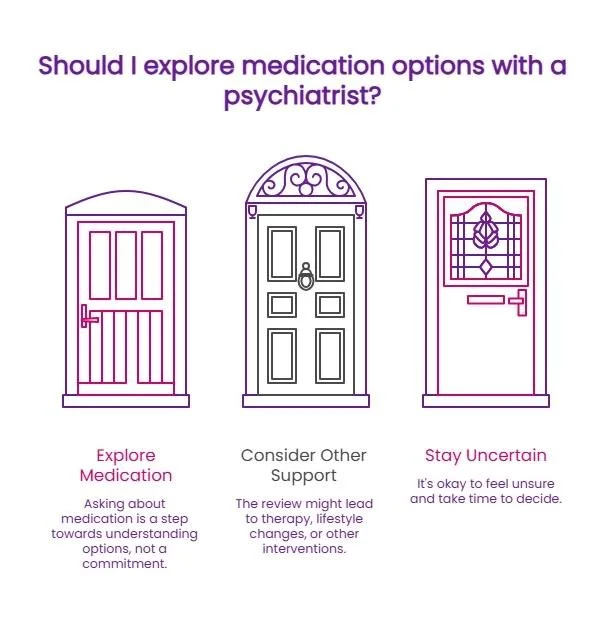
Exploring medication is not the same as agreeing to medication.
The most common fear about reaching out to a psychiatry practice is that asking about medication means the decision is already made. It isn't. You are allowed to ask questions before deciding on anything. A review is not the same as a commitment. A collaborative conversation should leave room for your concerns, your preferences, and your pace — including uncertainty, hesitation, and the desire to move slowly.
A medication review can be a conversation about fit. It can help clarify what you are experiencing, what has already helped, what has not, and what kind of support might make sense next. For some people, medication may be discussed as one possible support. For others, the conversation may point toward therapy, lifestyle support, integrative care, or a different first step altogether.
The purpose of an evaluation is not to arrive with a decision already made. It is to arrive with enough language to participate in the decision.
Why Medication Questions Can Feel So Loaded After Panic or Acute Anxiety
Panic compresses options. After panic attacks or a sudden rise in anxiety, even ordinary decisions can feel urgent. The calendar looks crowded. Sleep may feel unreliable. A subway ride, meeting, or dinner plan can start to feel harder than it used to.
In that state, the word "medication" can carry more meaning than the treatment itself. It may sound like proof that something is seriously wrong. It may bring up past experiences of not being heard. It may raise the fear that a clinician will focus only on symptoms and miss the full story of your life — that a complete history, set of values, and lived experience gets reduced to a symptom list.
That does not mean the fear is irrational. It means the conversation needs steadiness. Wanting support while wanting to move at your own pace is not a contradiction. It is a reasonable response to a significant decision.
What a Collaborative Medication Review Is Meant to Clarify
A collaborative medication review should not reduce you to a diagnosis or a prescription question. It should help clarify what is happening and what kind of support fits your situation.
At New York Integrative Psychiatry, Medication Management is grounded in comprehensive psychiatric evaluation, personalized treatment planning, and shared decision-making. In practical terms, that means the conversation may explore your current symptoms, history, goals, concerns, preferences, and broader care pathway.
A useful medication review may clarify:
what symptoms are disrupting daily life;
what you have already tried;
what goals matter most to you;
whether medication is being considered for stabilization support;
how medication might fit with therapy, movement, mindfulness, sleep work, or integrative wellness;
what you need to understand before deciding.
This is also consistent with guidance from the National Institute of Mental Health on mental health medications, which emphasizes working with a health care provider on a treatment plan that fits individual needs and medical circumstances.
Questions That Help Keep the Conversation Collaborative
The strongest way to lower pressure is to make the conversation specific. Bring questions that separate exploration from commitment.
Medication questions should create clarity, not pressure.
| Question to ask | Why it helps | What the answer may clarify | Pressure-reducing phrase |
|---|---|---|---|
| Are we deciding on medication today, or just exploring whether it might fit? | Separates exploration from commitment. | Whether the appointment is educational, evaluative, or decision-oriented. | "I'd like to understand the option before deciding." |
| What problem would medication be meant to help with in my day-to-day life? | Keeps the conversation tied to lived experience. | Whether the goal is panic reduction, steadier functioning, sleep support, or therapy engagement. | "Can we connect this to what I'm actually struggling with?" |
| How would medication fit with therapy or wellness support? | Prevents one-track framing. | Whether medication is being considered alone or as part of broader care. | "I want to understand the whole plan, not just one piece." |
| What would tell us this approach is helping? | Creates a shared way to evaluate progress. | What changes the clinician and patient would monitor together. | "How would we know this is moving me toward my goals?" |
| What happens if I want to go slowly? | Gives language for pacing. | Whether the clinician can discuss options, timing, and readiness openly. | "I'm open to learning, but I need the pace to feel manageable." |
| How often would we revisit the plan? | Reinforces that care is adjustable. | What follow-up and collaborative review may involve. | "I'd feel better knowing this is not a one-time irreversible decision." |
| If I feel more stable later, how would we talk about changing the plan? | Preserves future agency. | How the clinician approaches reassessment over time. | "I want to know how we would revisit this if my needs change." |
The NIMH guide to talking with a health care provider also supports preparing questions ahead of time, expressing concerns, and asking about other options when a recommendation feels unfamiliar. Bringing your own questions is preparation, not resistance.
How Medication Can Fit Into Whole-Person Anxiety Care
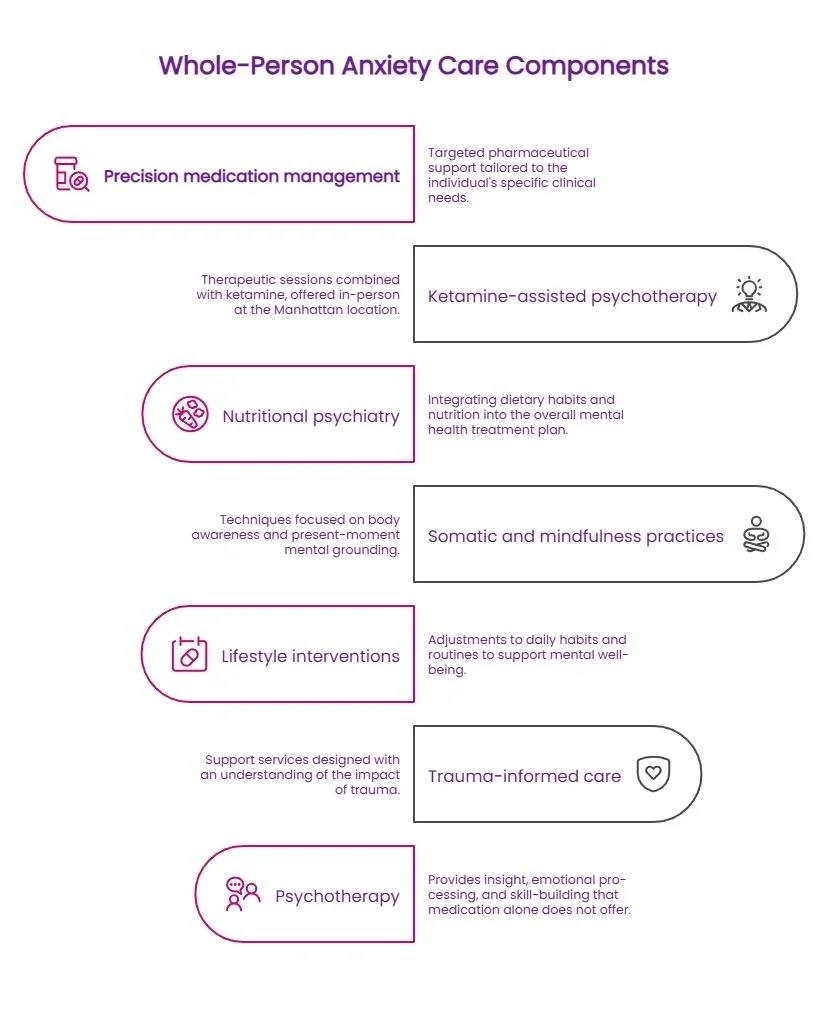
Medication may be one part of care — not the whole story.
For some people, medication may serve as stabilization — reducing the intensity of anxiety enough to engage more fully with therapy, movement, or mindfulness. For others, it may not be indicated at all. The distinction depends on symptoms, history, values, and clinical picture.
In a whole-person approach, medication is considered in relationship to the rest of a person's life. At New York Integrative Psychiatry, Integrative Psychiatry is framed around the full complexity of the person, not only symptom relief. That may include precision medication management, ketamine-assisted psychotherapy (offered in-person at our Manhattan location), somatic and mindfulness-based practices, lifestyle interventions, and trauma-informed care — coordinated supports shaped in partnership with the individual, not a menu of competing options.
Psychotherapy provides insight, emotional processing, and skill-building that medication alone doesn't offer. When medication becomes part of a plan, it typically works best alongside therapeutic work. A collaborative plan should help you understand how each part of care fits together — and the clinician-patient relationship is where these pieces are coordinated.
What to Say If You Feel Unsure, Pressured, or Afraid of Losing Control
Uncertainty does not have to shut the conversation down. It can become part of the conversation.
If the pace feels faster than you're ready for, these phrases can help you stay present without feeling pushed:
"I'm not against medication, but I'm nervous about feeling rushed."
"Can we talk through what you're seeing clinically and what options I have?"
"I want to understand what medication would be supporting, not just whether I should take it."
"Can we discuss how this might fit with therapy or other parts of care?"
"What would happen if I decided I'm not ready today?"
These are not confrontational questions. A thoughtful clinician will welcome them. The goal is to create enough clarity that your preferences, questions, and pace remain visible throughout the conversation.
When Anxiety Needs More Immediate Support Than a Blog Article Can Provide
If anxiety has reached a point where it feels unsafe — concerns about staying safe, thoughts of harming yourself or someone else, or a sense of immediate danger — please seek support now rather than continuing to read.
If you feel unable to stay safe, may harm yourself or someone else, or are in immediate danger, call 911, go to the nearest emergency room, or contact 988 in the U.S. The 988 Suicide & Crisis Lifeline — available by call, text, or chat — is a resource for people in suicidal crisis or acute mental health distress.
A Low-Pressure Next Step
You do not have to decide everything before reaching out.
If you are unsure whether medication review, therapy, or another form of support is the right first step, Message Us and ask what the first step may involve. You can also learn more about how psychiatric evaluation and collaborative decision-making fit a broader care pathway by visiting the Medication Management page.
Anxiety that disrupts daily life deserves attention. So does the fear of losing control of your own care decisions. The first step does not have to be a decision about medication. It can be a conversation that helps you feel steadier, clearer, and more in charge of what comes next.
Disclaimer: This article is for educational purposes only and is not a substitute for professional medical advice, diagnosis, treatment, emergency care, or an individualized psychiatric evaluation. If you feel unable to stay safe, may harm yourself or someone else, or are in immediate danger, call 911, go to the nearest emergency room, or contact 988 in the U.S.
About the New York Integrative Psychiatry Insights Team:
The New York Integrative Psychiatry Insights Team is our dedicated engine for synthesizing complex topics into clear, helpful guides. While our content is thoroughly reviewed for clarity and accuracy, it is for informational purposes and should not replace professional advice.