
Therapy, Medication Review, or Wellness Support? A Simple Care Path Map
📌 Key Takeaways
Anxiety care feels easier to choose when each option clarifies a different need, not a perfect answer.
Start With Clarity: The best first step is the path that helps explain your main concern.
Therapy Maps Patterns: Therapy may help you understand fear cycles, avoidance, relationships, and daily stress.
Medication Review Supports Decisions: A medication review may clarify symptoms, stability, and whether medication belongs in your care.
Integrative Psychiatry Connects Dots: Integrative psychiatry looks at sleep, stress, body signals, history, and goals together.
Wellness Supports Care: Wellness tools may support sleep and regulation, but they should not replace clinical evaluation.
Choose the path that helps you ask better questions, not the one that promises certainty.
People sorting through anxiety care options will gain a clearer starting point here, preparing them for the detailed overview that follows.
~ ~ ~ ~ ~ ~ ~ ~ ~ ~ ~ ~ ~ ~ ~ ~ ~ ~
When Every Care Option Seems Like It Could Be the Right One
Multiple tabs open. Therapy. Psychiatry. Medication Management. Wellness support. You are reading service descriptions while your body still carries some of the weight from the anxiety that sent you searching in the first place. That combination: physical unease, informational overload, and the pressure to make one good decision is more common than it might seem. It is not confusion. It is what responsible decision-making looks like when the stakes feel high, and the options feel opaque.
After anxiety escalates, the hard part is not always finding care options. Sometimes it is figuring out what each option is actually for.
Think of a care-path map the way you might think of a clear road sign after a frightening detour: it does not drive for you, but it orients you well enough that the next turn feels manageable. This article describes four care paths: Psychotherapy, Medication Management, Integrative Psychiatry, and Integrative Mental Health & Wellness — in terms of what each may help clarify, when it tends to be relevant, and what questions are worth bringing to a first conversation. It does not choose treatment. It helps you arrive at that conversation better prepared, which is the goal.
A Simple Way to Think About Anxiety Care Paths
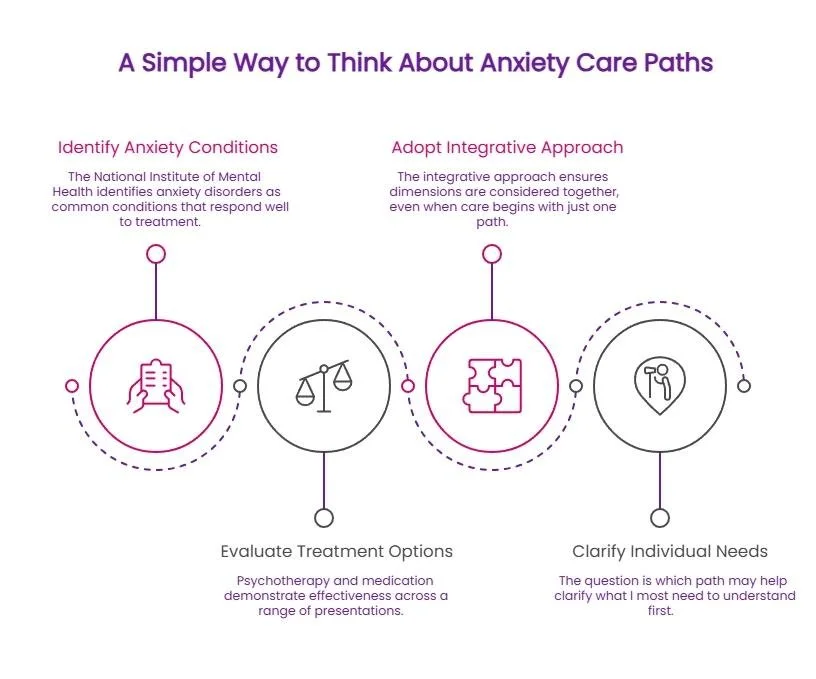
Care paths are not competing options. They are possible parts of a coordinated, whole-person approach to support. The National Institute of Mental Health identifies anxiety disorders as common mental health conditions that respond well to treatment, with both psychotherapy and medication demonstrating effectiveness across a range of presentations.
What that means in practice is that choosing one path does not close the door to others. Overlap between paths is not a problem — it is often the reason a collaborative evaluation is most useful. A narrow focus on any single approach — one protocol, medication without broader evaluation; wellness tools without clinical grounding — tends to miss something. The integrative approach exists precisely to ensure those dimensions are considered together, even when care begins with just one of them.
The question is rarely which path is the right answer, and more often which path may help clarify what you most need to understand first.
Care Path Comparison Matrix
| Care Path | What It May Help Clarify | When It May Be Relevant | Questions to Ask | What It Should Not Decide Alone |
|---|---|---|---|---|
| Therapy | Patterns, fear cycles, coping, relationships, emotional meaning, functioning | When anxiety affects daily life, avoidance, relationships, confidence, or emotional resilience | "What patterns are keeping this anxiety going?" / "What skills or deeper work might help?" | Whether medication is or is not appropriate |
| Medication Review | Symptoms, current medications, potential medication role, stability, treatment fit | When symptoms feel hard to manage, functioning is impaired, or medication questions exist | "What would medication be meant to support?" / "How would we evaluate fit?" | A full life-context formulation by itself |
| Integrative Psychiatry | Whole-person formulation and care sequencing | When anxiety feels connected to sleep, stress, body signals, history, trauma, goals, or multiple treatment options | "How do you decide what to address first?" / "How do therapy, medication, and wellness fit together?" | A guaranteed treatment outcome |
| Integrative Wellness | Nutrition, sleep, mindfulness, nervous-system regulation, lifestyle supports | When supportive tools are wanted alongside clinical care | "What supports could help my nervous system while I get care?" | Replacement for clinical evaluation when safety or functioning is seriously affected |
This map is for preparing questions, not choosing treatment alone.
Therapy: When You Need Space to Understand Patterns, Fear, and Functioning
Psychotherapy is a relational, personalized process. It draws from a range of evidence-informed approaches — psychodynamic therapy, cognitive behavioral therapy (CBT), mindfulness-based interventions, somatic techniques — adapted to each person's unique biology, history, and goals. The therapeutic relationship itself is central to how it works, not just the methods used within it.
This path tends to be most relevant when anxiety has begun affecting daily life in visible ways: avoidance patterns expanding, relationships feeling the strain, confidence eroding, or the emotional weight of ordinary tasks meaningfully increasing. That can look like avoiding the subway after a panic episode, bringing a quiet fear of losing control into every work meeting, or spending significant time mentally replaying a panic episode long after the physical symptoms have passed. Therapy unfolds over time rather than delivering rapid symptom relief — a distinction that matters when thinking about how care paths might be sequenced or combined.
Therapy should not be framed as just talking. It can help identify what the nervous system is doing, what the fear is protecting, and what patterns keep the cycle active. But therapy alone should not be used to rule medication in or out. That decision belongs in a clinical conversation.
Medication Review: When Stability, Symptoms, and Shared Decisions Need Attention
A Medication Management evaluation is not a prescription hand-off. It is a comprehensive psychiatric assessment — grounded in symptoms, medical history, current medications, and goals — conducted through shared decision-making. The American Psychiatric Association notes that anxiety disorders respond to both psychotherapy and medication, with the best approach depending on individual clinical factors rather than a single default.
A medication review may clarify whether medication is worth considering, continuing, adjusting, or simply discussing — and what it would be intended to support if recommended. The Mayo Clinic's overview of anxiety diagnosis and treatment describes psychotherapy and medication as common treatment categories while making clear that the right approach depends on the individual situation. Fit and informed choice are the operative values here. This path does not assume medication is the answer; it creates the conditions to find out whether it belongs in the picture.
Integrative Psychiatry: When the Picture Feels Bigger Than One Lane
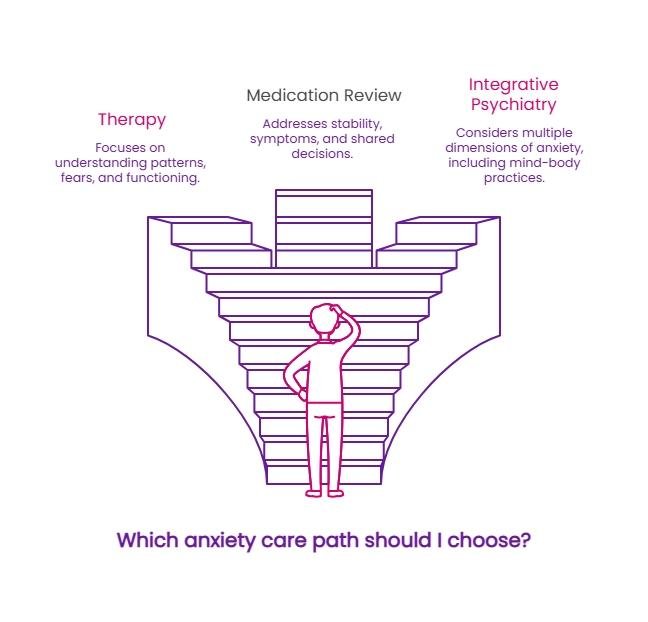
Integrative Psychiatry offers a wide-angle lens on care. It bridges evidence-based psychiatric approaches — psychopharmacology, psychotherapy — with holistic, mind-body practices that support healing across biological, emotional, psychological, and relational dimensions. This path is particularly relevant when anxiety does not feel like one isolated problem: when sleep is disrupted, stress is pervasive, body signals are prominent, or when you genuinely do not know whether the issue is primarily emotional, biological, stress-related, or some combination.
Integrative psychiatry does not mean addressing everything simultaneously. It means seeing the whole picture clearly enough to decide, together, where to begin.
Integrative Wellness: When Nervous-System Support, Sleep, Nutrition, and Regulation Matter
Integrative Mental Health & Wellness addresses the supportive layer of care: nutrition, nutraceuticals, mindfulness, nervous system regulation, sleep, and stress management. These are not generic lifestyle recommendations. Wellness guidance at this level is shaped by symptom patterns, clinical context, and—when medically indicated—diagnostic data, rather than guesswork.
Wellness support works best as a coordinated layer alongside clinical evaluation. When anxiety is tied to disrupted sleep, chronic stress, or physical dysregulation, it can meaningfully reinforce other care. What it cannot do is replace clinical evaluation when safety or functioning is seriously affected.
Questions to Bring to an Evaluation
Walking into a first appointment with questions already formed shifts the conversation. Instead of starting from uncertainty, you arrive with something to work from. The following are worth writing down before a first visit:
What are we trying to clarify first: symptoms, functioning, medication, patterns, safety, or support?
Would therapy, medication review, integrative psychiatry, or wellness support make the most sense as a first step?
How do you decide whether care should start with stabilization, deeper therapy work, medication questions, or supportive wellness tools?
How do you think about panic attacks or acute anxiety when functioning has changed?
What signs would suggest I need a different level of support?
How would we coordinate care if more than one path is relevant?
What should I track or notice before the first appointment?
How will we know whether the first step is helping?
I'm not sure what kind of support I need yet — what information would help us figure out the right starting point?
When a Care Map Is Not Enough
This article is educational. It cannot evaluate the urgency of individual symptoms, assess safety risk, or replace clinical judgment. New York Integrative Psychiatry does not offer after-hours or emergency assessments.
If symptoms feel medically urgent, involve immediate safety risk, or feel beyond the scope of outpatient support, please call 911, go to the nearest emergency room, or contact the 988 Lifeline — available 24 hours by call or text — which provides free, confidential crisis support and connection to mental health services.
A Clearer First Step Can Reduce the Fear of Choosing Wrong
Ultimately, this overview replaces the experience of scrolling through options while your body still feels unsettled, giving you a clearer sense of what each clinical path clarifies and what questions to ask when you arrive.
You do not need to arrive at a first conversation with everything sorted. You need a sense of what you most want to understand, and a willingness to let the conversation do some of the work. The goal is not to choose perfectly. It is to understand what brought you here well enough to take a thoughtful next step toward where you want to be.
If you are unsure which kind of support fits, that uncertainty itself is a reasonable starting point. Message Us to begin with a conversation about what kind of care may fit your symptoms, goals, and next step — no decision required before you reach out. The goal is to stop choosing alone.
Disclaimer: This article provides general information about choosing between therapy, medication review, psychiatry, and integrative wellness support for educational purposes. Individual circumstances vary significantly based on factors like symptom intensity, functional disruption, medical history, current medications, safety concerns, and personal treatment goals. For personalized guidance tailored to your anxiety care pathway, consult with a qualified mental health professional.
By: The New York Integrative Psychiatry Insights Team
Our dedicated engine for synthesizing complex topics into clear, helpful guides. While our content is thoroughly reviewed for clarity and accuracy, it is for informational purposes and should not replace professional advice.