
From Panic Readiness to Whole-Person Care: A Personal Journey Guide
📌 Key Takeaways
A panic episode matters most when it changes how you live, not just how intense it felt.
Impact Matters Most: Lasting changes in sleep, work, relationships, or routines may make support worth exploring.
Patterns Beat Panic: Repeated fear, avoidance, or body-checking can show that self-management may not be enough.
Whole-Person Care Helps: A full evaluation looks at sleep, stress, health, history, substances, and personal goals.
First Steps Stay Flexible: Reaching out can begin a fit conversation, not a fixed treatment commitment.
Care Is Collaborative: Therapy, medication review, and wellness support can work together when clinically appropriate.
Panic may start as an alarm, but care can begin as a steady map.
Adults feeling unsure after panic will gain calm next-step clarity here, preparing them for the detailed overview that follows.
~ ~ ~ ~ ~ ~ ~ ~ ~ ~ ~ ~ ~ ~ ~ ~ ~ ~
The episode is over. Your breathing has slowed, the chest's tightness has lifted, and the room looks normal again — but your mind is still replaying it. The racing heart. The sudden wave of dread. The moment when you weren't sure what was happening inside your own body. What was that? What does it mean? What am I supposed to do now?
For many people, this is where the real confusion begins: not during the panic itself, but in the quiet that follows. The body has calmed, yet the mental replay continues, and the question hanging over the rest of the day is whether this was a one-time alarm or the beginning of something that needs attention.
Panic readiness is the term for this specific moment — the decision-making stage in which you evaluate whether a recent panic attack, acute anxiety escalation, or noticeable shift in daily functioning may indicate that structured outpatient care is worth exploring. Think of it like a warning light on your dashboard. The light itself doesn't tell you whether you can keep driving carefully or whether the car needs a trusted professional to look under the hood. That determination requires a closer look at the full picture.
This guide is not a diagnostic tool, and it cannot tell you what your experience means or whether treatment is necessary. If you feel unsafe, may harm yourself or someone else, have chest pain, fainting, severe shortness of breath, or new neurological symptoms, call 911 or go to the nearest emergency department. Nationwide, you can call or text 988 for free, confidential mental health crisis support. New York Integrative Psychiatry is not an emergency resource and does not offer after-hours or emergency assessments.
What this guide does offer is a map — a calm, practical sequence for moving from symptom alarm toward a clearer sense of whether and how to take the next step.
The path moves through five stages:
Panic Recognition — naming what happened without turning it into a verdict
Readiness Clarity — examining patterns and functioning, not just the intensity of the episode
Whole-Person Evaluation — widening the lens to the fuller picture of your health and life
Care Pathway Fit — identifying which first door might make sense for you
Collaborative Plan — understanding what happens after you reach out
When Panic Becomes a Care-Path Question
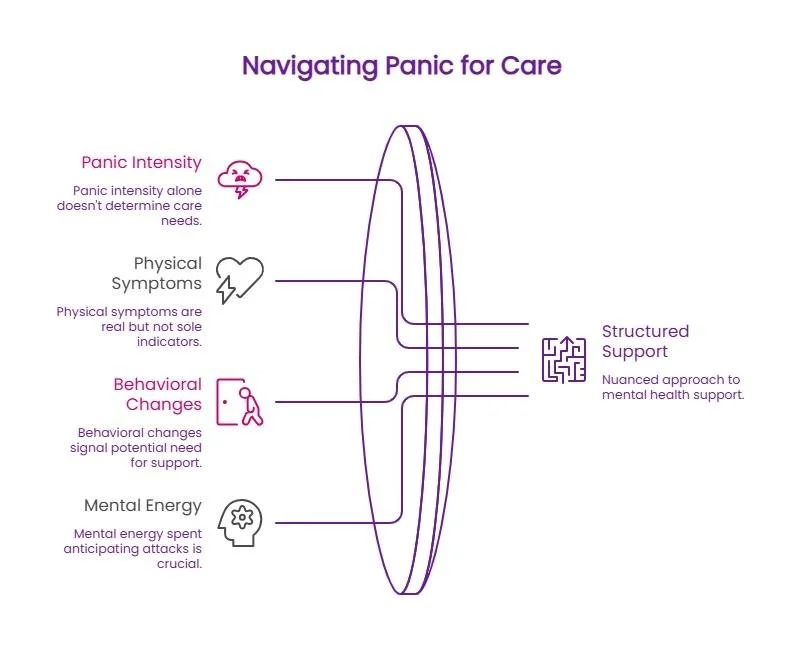
Panic intensity alone does not decide the next step.
A panic attack can feel catastrophic in the moment. According to the National Institute of Mental Health, panic attacks can include intense fear and physical symptoms such as a racing heart, sweating, trembling, chest discomfort, dizziness, or shortness of breath. The body produces what registers as a genuine threat response — even when no external danger is present. That experience is real.
It is also not, by itself, a reliable guide to what comes next.
The intensity of the episode does not automatically determine whether outpatient care is appropriate. Many people have a frightening panic experience and never have another. Others find that something quietly shifts in the weeks that follow: they begin avoiding situations, their sleep changes, or they spend significant mental energy anticipating the next episode. Anxiety disorders, including panic disorder, are among the most common and treatable mental health conditions — but whether any single experience crosses into a pattern that warrants structured support requires a more nuanced look.
A better question than "how bad was it?" is this: what has changed in how you move through daily life since it happened?
Step 1: Separate Alarm from Readiness
Readiness is about patterns, impact, support, and capacity — not the intensity of the episode itself.
Panic can feel urgent in the body. Readiness is a different kind of assessment — one that looks at patterns, functioning, and whether your current resources feel adequate for what you're managing.
The following are reflection prompts, not diagnostic criteria. None of them, individually, indicates that outpatient treatment is required:
Repeated panic episodes or persistent anxiety that isn't resolving on its own
Avoiding places, situations, or activities for fear of a recurrence
Disrupted sleep — difficulty falling asleep, waking with anxiety, or unrefreshing rest
Difficulty concentrating at work or withdrawing from relationships
Spending significant time checking your body or seeking reassurance throughout the day
A persistent sense that something is wrong and that self-management alone isn't enough
Patterns like these, when they appear and linger, suggest that a readiness conversation may be worth having — not as a commitment to any particular treatment, but as a first step toward understanding what kind of support might genuinely help. As the American Psychiatric Association notes, anxiety disorders can affect daily functioning, relationships, and work or school performance. That doesn't mean every anxious experience is a disorder — but impact matters, and readiness begins with honest observation.
If at any point you feel unsafe, or experience thoughts of harming yourself or others, please contact emergency services rather than waiting to explore outpatient options.
Step 2: Name What Changed After the Panic Episode
The clearest readiness signal is a shift in how you navigate ordinary life — not just the memory of the panic itself, but the behavioral changes that followed.
The following are hypothetical scenarios offered for illustration only, not as diagnostic indicators:
You started taking a longer route to work because the train platform brought back physical sensations. You canceled plans rather than explain what happened, uncertain you could be fully present even if you tried. You checked your pulse several times during your lunch break, hours after the episode had already passed. You went through meetings and conversations while part of your attention was quietly scanning your body for early warning signs.
These kinds of shifts — avoidance, hypervigilance, disrupted routines — can be quiet, easy to rationalize, and significant. They represent the difference between a frightening but isolated experience and an ongoing pattern that is using attention, energy, and confidence. Naming those changes honestly, without minimizing or catastrophizing them, is a meaningful first step toward understanding what might help.
Step 3: Bring the Whole-Person Picture into Focus
A whole-person evaluation expands the clinical focus from the isolated panic episode to the comprehensive context of your overall health. If the panic episode is the alarm, this evaluation provides the complete diagnostic picture. Rather than focusing only on the symptom, it asks what may be shaping it: sleep quality, stress levels, physical health, relationship context, trauma history, medication and substance use, and what the person wants their life to feel like again.
This is the foundation of integrative psychiatry — a whole-person psychiatric approach that considers symptoms alongside biology, medication options, lifestyle factors, therapeutic context, and personal goals. It widens the frame from "what is wrong" to "what is the fuller picture of this person's health and life right now."
A whole-person evaluation may explore:
Sleep, nutrition, and physical health patterns
Recent stressors, life transitions, or significant losses
History of trauma or adverse experiences
Previous therapy or medication experiences and how they went
Substances — including caffeine and alcohol — that may affect the nervous system
Values, personal goals, and what matters most in daily functioning
Preferred pace and readiness to engage with care
This wider picture is not about finding more things that are wrong. It is about understanding the conditions contributing to anxiety so that any support offered is genuinely matched to the person — not applied uniformly to a complex situation. The NICE guideline on generalized anxiety disorder and panic disorder in adults recommends a stepped-care approach in which the type and level of support is calibrated to the individual's specific needs and presentation. In practical terms, care does not have to begin with the most intensive option. It can start with the right level of support for the situation.
Step 4: Choose the First Care Door, Not the Whole Future
Reaching out initiates the first stage of clinical care. It begins a conversation about fit, goals, and what the next step might look like — not a binding contract with a predetermined outcome.
A common reason people hesitate to reach out is the belief that doing so commits them to a specific path — that contacting a psychiatrist means agreeing to medication, or that starting therapy means signing on for years of work before anything gets better. That hesitation is understandable.
Psychotherapy is a relational, evidence-informed process drawing from approaches such as cognitive behavioral therapy, psychodynamic therapy, and mindfulness-based methods, tailored to your biology, history, and goals. It is particularly useful when someone wants space to understand fear, avoidance, stress, trauma context, or body-based anxiety patterns.
Integrative psychiatric evaluation considers the full clinical picture, leading to collaborative treatment planning that may or may not include medication depending on what is appropriate for your situation.
Medication management is a shared decision-making process, not an automatic prescription. For some people, medication review is a useful component of a broader plan; for others, it may not be indicated.
Integrative mental health and wellness support connects mental health with nutrition, sleep, stress management, mindfulness, and nervous system regulation — addressing the physical and behavioral dimensions of anxiety alongside its psychological ones.
Ketamine-based interventional care — offered in person at our Manhattan office — may also be relevant for some individuals in specific clinical contexts, though it is not a default pathway for anxiety or panic escalation.
The right first door is the one that fits where you are right now.
The Personal Journey Map: From Panic Recognition to a Care Plan
The path from panic to care can be mapped one steady step at a time.
The table below is a reflection tool, not a clinical protocol. It is designed to help you organize your thinking before — or alongside — reaching out for support.
| Stage | Your Question | What This Stage Is For | What to Prepare |
|---|---|---|---|
| Panic Recognition | "What happened, and what am I worried it means?" | Naming the experience without turning it into a diagnosis. | When it happened, what you noticed, what helped, what still concerns you. |
| Readiness Clarity | "Is self-monitoring still enough?" | Looking at functioning, recurrence, avoidance, sleep, fear, and confidence since the episode. | Specific examples of how your daily life has changed. |
| Whole-Person Evaluation | "What else might be shaping this?" | Widening the lens beyond the panic episode itself. | Stressors, sleep patterns, body signals, history, medications, previous therapy, and personal goals. |
| Care Pathway Fit | "Which first door might make sense?" | Considering therapy, psychiatry, medication review, wellness support, or another starting point. | Questions you want answered before committing to anything. |
| Collaborative Plan | "What happens after I reach out?" | Turning concern into a flexible, personalized next step. | Your preferences, pace, concerns, existing providers, and support network. |
A map does not erase uncertainty. It makes uncertainty easier to carry.
How to Explain the Decision to Yourself or Someone You Trust
One of the quieter challenges in reaching out is finding the words — for your own clarity, and for the moments when someone close asks what you are thinking. Having a clear, honest way to frame the decision can reduce the sense of pressure in either direction.
Here is a script you can adapt:
"I'm not saying I know exactly what this was or what kind of support I need. I'm saying the panic episode changed how I'm functioning and how safe I feel in my body. I want to talk with someone who can help me understand whether outpatient care makes sense, and what kind of support might be a good fit."
If a shorter version feels more natural, this one works too:
"I'm not trying to overreact. I'm trying to understand what changed and what support would be appropriate."
Three reflection prompts may help before that conversation:
What changed after the episode that you don't want to keep managing on your own?
What would you want a clinician to understand about your body, your story, and your goals?
What would make a first conversation feel less pressured?
There are no required answers. Some people arrive with clear, organized thoughts; others come with only the sense that something needs to shift. Both are legitimate starting points for a care conversation.
What Reaching Out Can Look Like at New York Integrative Psychiatry
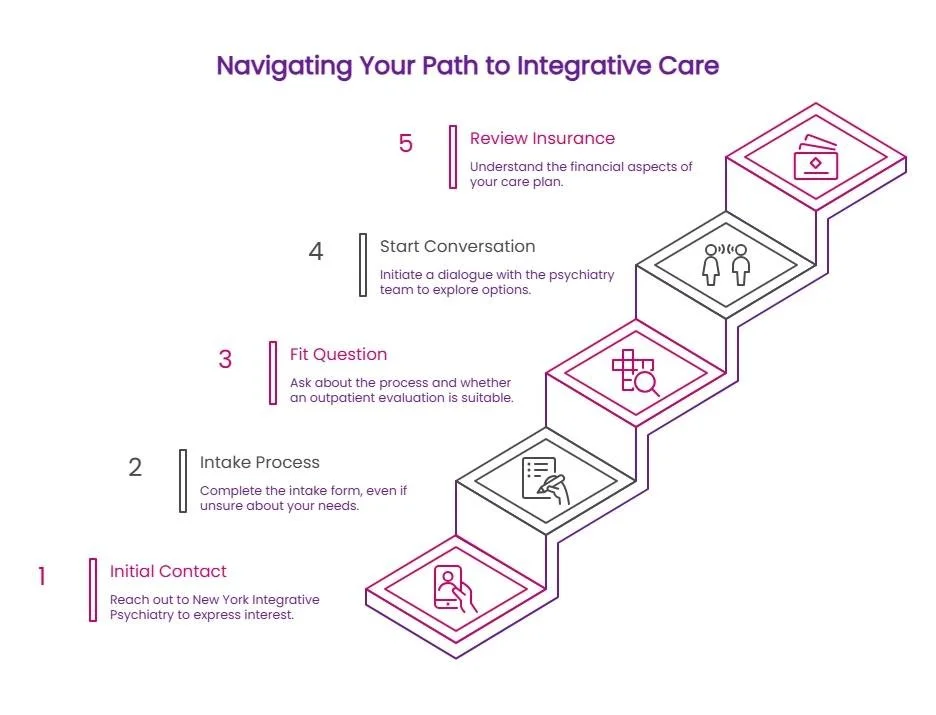
New York Integrative Psychiatry offers integrative psychiatry, psychotherapy, medication management, ketamine-assisted psychotherapy and integrative mental health and wellness support in a whole-person care context for adults across New York. Services are available in person and virtually depending on location and service type; ketamine is offered in person at the Manhattan office only.
If you are not yet certain what kind of support fits, you do not need to arrive with the answer. The intake process accommodates that uncertainty: one option in the contact form is simply, "I'm unsure about what I need but would like to find out more."
You can begin with a question about fit — what the process looks like, and whether an outpatient evaluation may be a reasonable next step for where you are right now.
Message New York Integrative Psychiatry to start that conversation, or text or call (646) 859-2339. If cost or insurance questions are part of your decision, review Insurance & Billing rather than assuming coverage — financial details vary by plan and circumstance.
Frequently Asked Questions
Does having a panic attack mean I need anxiety treatment?
Not automatically. A single panic episode does not confirm a clinical need for structured treatment. The more relevant question is whether the episode has led to lasting changes in functioning, persistent avoidance, recurring symptoms, or a level of distress that self-management alone isn't adequately addressing. Those patterns are worth exploring with a qualified clinician.
How do I know whether outpatient anxiety care is the right next step?
Readiness depends on the person — their functioning, their history, and their capacity to engage with care at this moment. A useful question to sit with: has this experience changed how you move through daily life, and do those changes feel sustainable without support? If the honest answer is no, reaching out for an evaluation is a reasonable path forward.
What does a whole-person psychiatric evaluation look at?
Beyond symptoms, a whole-person evaluation considers the broader context of a person's health: sleep, stress, physical history, medication and substance use, trauma history, previous therapy experiences, personal values, and goals. The aim is to understand what may be contributing to the presenting concern and what kind of support would genuinely fit — rather than applying a uniform response to a complex situation.
Can therapy, medication review, and wellness support work together?
Yes. These approaches are not mutually exclusive. Many people benefit from some combination of psychotherapy, medication evaluation, and integrative wellness support, coordinated around a shared understanding of their needs and goals. The specific combination is not predetermined — it emerges from a collaborative process between the person and their care team.
A Steady Next Step
The quiet after panic can make every option feel too large. But you don't have to choose between ignoring the alarm and treating it as a final verdict.
The next step begins with one question: what kind of support would help you understand what changed? Name the impact. Look at the pattern. Widen the lens. Ask about fit. Let the plan develop collaboratively.
Panic may start as an alarm. Care can begin as a map.
Disclaimer: This article is for informational and educational purposes only and is not a substitute for professional diagnosis, medical advice, psychotherapy, psychiatric evaluation, or emergency care. If you may harm yourself or someone else, feel unsafe, have chest pain, fainting, severe shortness of breath, new neurological symptoms, or need immediate medical attention, call 911 or go to the nearest emergency department. In New York City, you can call or text 988 for free, confidential mental health crisis support. New York Integrative Psychiatry is not an emergency resource and does not offer after-hours or emergency assessments.
About the New York Integrative Psychiatry Insights Team:
The New York Integrative Psychiatry Insights Team is our dedicated engine for synthesizing complex topics into clear, helpful guides. While our content is thoroughly reviewed for clarity and accuracy, it is for informational purposes and should not replace professional advice.